






















Focus and Scope
MENTOR Revista de Investigación Educativa y Deportiva is an Ecuadorian, multidisciplinary, open-access scientific journal published in electronic format.
e-ISSN: 2806-5867
Publisher: Colegio de Profesionales de Recreación, Actividad Física y Deporte (COLPRAFYD)
Address: Calderón Parish, El Arenal Street and Panamericana Norte, Casales Buenaventura Complex, Phase 3, House 49, 1st Floor, Postal Code 170202, Quito, Ecuador.
Contact email: info@colprafydoficial.org
Institutional website: https://colprafydoficial.org/services
The journal aims to publish and disseminate scientific research in three main areas: Education and Educational Sciences; Physical Activity, Exercise and Sport; and Health Sciences. Its multidisciplinary scope encompasses research conducted within each of these areas, as well as studies that integrate two or more of them.
Education and Educational Sciences
The journal considers research related to educational processes, pedagogy, didactics, curriculum, assessment, teacher education, educational management, inclusion, interculturality, educational technology, educational innovation, and other topics within the educational sciences.
Physical Activity, Exercise and Sport
The journal considers research related to physical education, physical activity, exercise, sports training, performance, recreation, applied sport sciences, sport psychology, sport management, and other related fields.
Health Sciences
The journal considers research related to public health, nursing, medicine, physiotherapy, rehabilitation, nutrition, health promotion and prevention, well-being, and other fields within the health sciences.
Given its multidisciplinary nature, MENTOR also welcomes research that integrates two or more of these areas. Manuscripts must clearly fall within at least one of the areas declared in the journal’s focus and scope. Manuscripts whose primary subject falls exclusively outside Education and Educational Sciences, Physical Activity, Exercise and Sport, or Health Sciences will not be considered for evaluation.
The journal is intended for researchers, professionals, faculty members, and higher-education students working in the areas covered by its scope, with a national, Ibero-American, and international reach.
MENTOR accepts contributions in Spanish and English under the following categories:
Original Research Articles
These present unpublished research findings using quantitative, qualitative, or mixed-method approaches, with methodological designs appropriate to the research problem, objectives, and nature of the study.
Review Articles
These integrate, analyze, and critically synthesize the existing scientific literature on topics within the journal’s focus and scope.
Theoretical Essays
These develop analyses, reflections, conceptual proposals, or academic arguments grounded in scientific literature and specialized scholarly debate.
Manuscripts that pass the initial editorial screening are submitted to external double-blind peer review in accordance with MENTOR’s editorial policies.
Each published article is assigned a Digital Object Identifier (DOI). Long-term digital preservation is provided through the Public Knowledge Project Preservation Network (PKP PN).
Publication Frequency
MENTOR is published every four months, with three regular issues per year, in January, May, and September.
The journal may also publish special issues according to its editorial planning. The publication of special issues does not alter the frequency of regular issues. All content published in regular or special issues must fall within MENTOR’s declared focus and scope. Articles published in special issues undergo the same editorial evaluation and external peer-review process as articles published in regular issues.
Academic and Scientific Community
MENTOR is intended for the academic and scientific community comprising researchers, professionals, faculty members, and higher-education students in Education and Educational Sciences; Physical Activity, Exercise and Sport; and Health Sciences.
Its multidisciplinary nature promotes scientific communication within and across these areas and encourages the participation of national, Ibero-American, and international academic communities associated with the fields declared by the journal.
Editorial Quality Process
MENTOR applies quality-control procedures throughout the different stages of manuscript evaluation, editing, and production in order to ensure thematic relevance, academic rigor, editorial integrity, and the formal quality of its published content.
Initial Editorial Screening
The editorial team verifies that the manuscript falls within MENTOR’s focus and scope, complies with the author guidelines, includes the required metadata, preserves the anonymity required for peer review, and follows the structure corresponding to the type of contribution.
At this stage, a similarity check is also performed using Turnitin. Similarity reports are reviewed by the editorial team and are not automatically interpreted as evidence of plagiarism.
Manuscripts that fall outside the journal’s focus and scope are rejected at this stage and are not sent for peer review.
Reviewer Assignment
Manuscripts that pass the initial editorial screening are sent to external reviewers with academic or research expertise related to the manuscript’s subject area and object of study.
Double-Blind Peer Review
Evaluation is conducted under a double-blind peer-review model, maintaining the confidentiality of the identities of authors and reviewers throughout the process. Each manuscript is evaluated by at least two independent reviewers.
Reviewers provide reasoned recommendations concerning the academic and methodological quality of the manuscript. The final editorial decision is made by the responsible editor, taking into consideration the reviewers’ reports and the journal’s editorial policies.
When the requested revisions require a new academic assessment, the manuscript may be sent for further review before the corresponding editorial decision is made.
Copyediting
Accepted manuscripts undergo editorial revision to verify clarity, coherence, linguistic accuracy, consistency among sections, and compliance with MENTOR’s editorial standards.
Translation Review
English-language elements, including the title, abstract, and keywords, are reviewed to verify their correspondence with the original content and their linguistic accuracy.
Layout
Accepted articles are formatted in accordance with MENTOR’s established editorial design, ensuring consistency in the presentation of text, tables, figures, references, and other elements of the article.
Author Proof
After layout, authors receive a proof of the article to verify authorship information, affiliations, content, tables, figures, and possible production errors before final publication.
Final Production Check
Before publication, the editorial team conducts a final check of metadata, DOI, author names, affiliations, references, licensing information, tables, figures, spelling, formatting, and consistency between the available versions of the article.
Corrections made at this stage are limited to editorial and production matters and do not alter the scientific results or conclusions approved during the evaluation process.
Ethical and Editorial Commitment
MENTOR manages manuscripts in accordance with its policies on publication ethics, academic integrity, authorship, conflicts of interest, corrections, retractions, open access, and research ethics.
The journal follows the guidance of the Committee on Publication Ethics (COPE) and the Principles of Transparency and Best Practice in Scholarly Publishing.
Open Access Policy
MENTOR is an open-access journal. All of its content is freely and immediately available to readers, without embargo periods or registration or subscription requirements.
Users may read, download, store, print, search, link to, and share published content in accordance with the conditions established by the applicable license.
All content is published under the Creative Commons Attribution-NonCommercial-NoDerivatives 4.0 International License (CC BY-NC-ND 4.0).

Copyright and Licensing
Authors retain copyright over their work and grant MENTOR the right of first publication.
Each published article identifies its authors as the copyright holders and displays the Creative Commons Attribution-NonCommercial-NoDerivatives 4.0 International License (CC BY-NC-ND 4.0).
Reuse Policies
Authors may share and deposit permitted versions of their work in accordance with MENTOR’s self-archiving policy and the terms of the applicable license.
Manuscripts submitted to MENTOR must not be simultaneously under consideration by another journal.
If authors wish to withdraw a manuscript during the editorial process, they must formally notify the Editorial Board at rjposso@revistamentor.ec and state the reasons for the withdrawal request.
Affiliation
MENTOR Revista de Investigación Educativa y Deportiva is affiliated with the Colegio de Profesionales de Recreación, Actividad Física y Deporte (COLPRAFYD).
Funding
MENTOR Revista de Investigación Educativa y Deportiva is funded by the Colegio de Profesionales de Recreación, Actividad Física y Deporte (COLPRAFYD).
Author Charges
MENTOR does not charge authors or their institutions any fees for manuscript submission, editorial evaluation, peer review, editorial processing, copyediting, translation review, layout, publication, page charges, nor for DOI assignment.
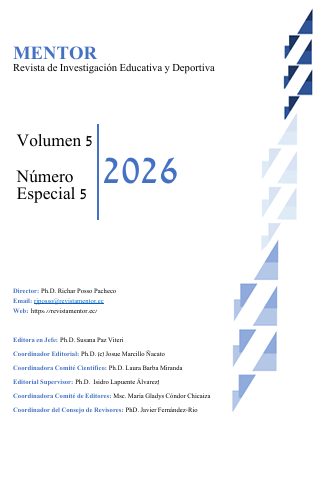
MENTOR Revista de Investigación Educativa y Deportiva
MENTOR is a multidisciplinary, open-access scientific journal that publishes research in the areas of Education and Educational Sciences; Physical Activity, Exercise and Sport; and Health Sciences.
The journal publishes three regular issues per year, in January, May, and September, and may also publish special issues according to its editorial planning.
Manuscripts undergo an initial editorial screening and, when they comply with the journal’s focus, scope, and requirements, are submitted to external double-blind peer review.
Access to all content is free and immediate. MENTOR does not charge authors or their institutions any fees for manuscript submission, evaluation, peer review, editorial processing, or publication.
Please consult the Focus and Scope and the Publication Guidelines before submitting a manuscript.



Part of the
PKP Publishing Services Network
 +593987341121
Email: rjposso@revistamentor.ec
MENTOR Revista de Investigación Educativa y Deportiva
Quito-Ecuador
ISSN 2806-5867
MENTOR Revista de Investigación Educativa y Deportiva is licensed under a Licencia Creative Commons Atribución-NoComercial-SinDerivadas 4.0 Internacional